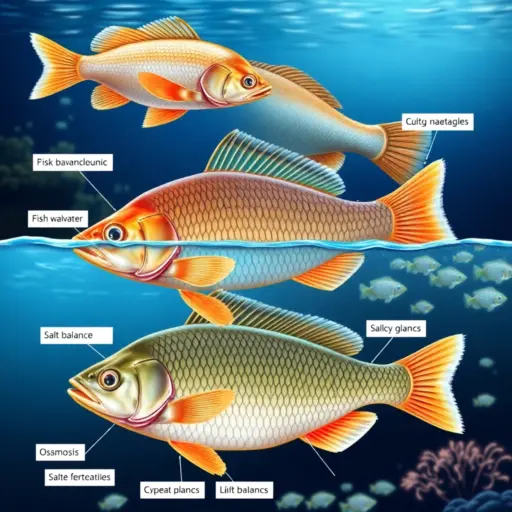
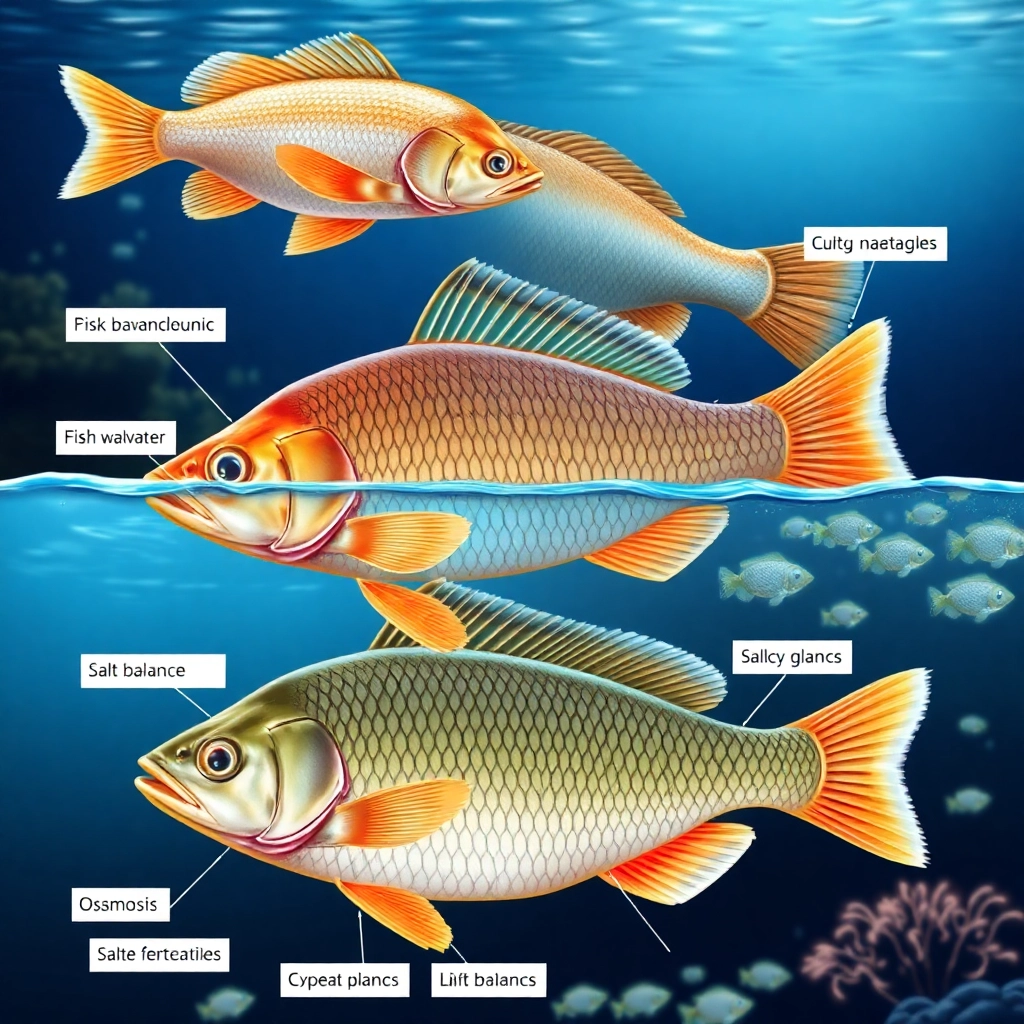

I set out to explain why seemingly robust river species fail in the ocean. Although the answer looks simple, the physiology is exquisitely nuanced. Therefore, I examined water movement across membranes, ionic gradients, and energy costs. Moreover, I connected cell transport with whole-animal outcomes, including survival times and behavior. Consequently, I framed the question within homeostasis and evolutionary adaptation across aquatic habitats. Finally, I show how freshwater fish face fundamental osmotic challenges that, without specialized machinery, quickly overwhelm normal function.
At first glance, salt appears harmless because fish already live submerged in water. However, dissolved ions radically change water’s effective chemical pressure. Therefore, diffusion and osmosis impose relentless forces on tissues, gills, and kidneys. Moreover, environmental salinity sets the direction of water and ion fluxes. Consequently, the ocean’s high solute load pulls water from bodies while driving salts inward. Thus, without countermeasures, dehydration, acidosis, and nervous dysfunction follow with surprising speed.
Because language can confuse, I anchor this explanation in measurable variables. Therefore, I compare freshwater at near zero practical salinity units with seawater near 35. Moreover, I translate those values to osmolarity and tonicity, which better predict fluxes. Additionally, I identify the transporters that move ions against gradients at the gills. Consequently, biochemical capacity, not desire, determines whether a fish can persist. Finally, exceptions exist, yet they prove the rule by revealing costly, complex physiological upgrades.
My Learning Objectives for Explaining Why Freshwater Fish Cannot Survive in the Sea
I aimed to articulate a clear, mechanistic pathway from environment to organismal failure. Therefore, I specified how salinity differences translate into osmotic stress at cellular interfaces. Moreover, I planned to quantify expected water and ion fluxes using standard physiological parameters. Consequently, my first objective was to connect diffusion laws with observed mortality patterns in naïve river species.
Next, I set goals to map gill ionocyte function to environmental salinity. Therefore, I focused on Na+/K+-ATPase, NKCC cotransporters, and apical chloride channels. Moreover, I considered aquaporins, tight junction proteins, and boundary layer dynamics. Consequently, I would link structural changes in gills to measurable ion excretion under oceanic exposure.
I also planned to evaluate renal contributions. While gills dominate ion traffic, kidneys set urine volume and composition. Therefore, I contrasted dilute, high-volume urine in rivers with concentrated excretion strategies offshore. Moreover, I assessed endocrine control by cortisol and prolactin during transitions. Consequently, this integration would clarify why many freshwater fish cannot suddenly ocean-adapt.
Finally, I intended to address exceptions and evolution. Therefore, I examined euryhaline species, smoltification in salmon, and acclimation time courses. Moreover, I evaluated energy budgets, because transport costs scale with gradient strength. Consequently, I would quantify trade-offs that restrict broad salinity tolerance. Ultimately, these objectives guided a rigorous, evidence-based explanation.

What I Needed to Know First: Prerequisites and Key Terminology
I began with salinity, osmolarity, and tonicity. Although related, they answer different questions. Salinity measures total dissolved salts, while osmolarity counts particles affecting water movement. Therefore, tonicity predicts cell volume change across a membrane. Moreover, seawater’s high osmolarity imposes hypertonic conditions relative to vertebrate plasma. Consequently, understanding these terms made later mechanisms intuitive.
I reviewed diffusion, osmosis, and active transport. Diffusion and osmosis proceed down gradients without energy. However, active transport requires ATP to move solutes uphill. Therefore, membrane proteins and ion pumps define physiological limits. Moreover, transporter expression levels and localization determine achievable flux rates. Consequently, fish survival depends on matching transporter capacity to environmental demands.
I distinguished stenohaline and euryhaline strategies. Stenohaline organisms tolerate narrow salinity ranges, while euryhaline species manage broad ranges. Therefore, the latter deploy regulatory plasticity and remodeling. Moreover, smoltification in salmon exemplifies orchestrated endocrine and morphological change. Consequently, without that shift, river animals fail when placed in the sea.
Gill anatomy required review. Ionocytes, formerly called chloride cells, cluster in filament epithelia and lamellae. Therefore, they control NaCl uptake or secretion depending on environment. Moreover, tight junction architecture sets paracellular permeability. Additionally, boundary layer thickness influences diffusion rates at the gill surface. Consequently, structure determines function and stress vulnerability.
Finally, I surveyed baseline environmental ranges. Fresh waters often sit below one practical salinity unit, while oceans average thirty-five. Therefore, the gradient is steep and persistent. Moreover, transitional habitats like estuaries fluctuate daily and seasonally. Consequently, only flexible physiologies can endure there. For additional context, the NOAA resources on marine conditions provided useful background definitions.
How I Built the Theoretical Framework: Osmoregulation and Transport in Fish Physiology
I grounded the framework in thermodynamics and membrane transport. Therefore, I mapped chemical potentials to water movement. Moreover, I applied Fick’s law for diffusive fluxes and included reflection coefficients. Additionally, I incorporated active transport through Na+/K+-ATPase work terms. Consequently, predicted fluxes revealed how small membrane permeabilities still cause large cumulative exchanges.
Next, I parameterized gill exchange surfaces. While gills maximize gas transfer, they also increase ion exchange. Therefore, high surface area and thin epithelia accelerate both oxygen uptake and salt-water flux. Moreover, boundary layer properties and ventilatory flow alter effective gradients. Consequently, respiratory efficiency creates osmoregulatory challenges in saline habitats.
I represented renal function using clearance concepts. Therefore, I contrasted dilute urine production in rivers with concentrating mechanisms offshore. Moreover, I included gastrointestinal transport, because marine species drink seawater. Consequently, intestinal ion pumps and water channels become essential under hyperosmotic stress. This framework predicted constraints limiting many freshwater fish in marine conditions.
I incorporated hormonal regulation to complete the model. Cortisol tends to promote seawater adaptations, while prolactin supports freshwater strategies. Therefore, endocrine signals reprogram transporter expression and ionocyte type. Moreover, remodeling requires time, gene transcription, and cellular turnover. Consequently, abrupt transfers outpace physiological plasticity, leading to failure before adjustments finish.
What I Observed in Freshwater vs Saltwater Fish: Comparative Physiology of Salinity Tolerance
In rivers, plasma osmolarity exceeds ambient water. Therefore, water diffuses inward, and ions tend to diffuse outward. Moreover, uptake transporters retrieve salts at the gill, while kidneys expel excess water. Consequently, high-volume, dilute urine maintains homeostasis. However, these settings prime systems for one direction of flux, not the other.
In the ocean, ambient osmolarity exceeds plasma. Therefore, water leaves the body, and salt loads rise passively. Moreover, marine teleosts drink seawater, absorb water intestinally, and secrete ions at gills. Consequently, they produce low-volume urine while actively excreting monovalent salts. This architecture opposes the river blueprint.
Comparing gill ionocytes revealed directional specialization. Freshwater types express transporters for uptake, including apical Na+ channels and cotransporters. However, marine types express apical chloride channels with basolateral NKCC. Therefore, flipping direction requires rewiring protein composition and polarity. Moreover, insufficient ionocyte remodeling leaves freshwater fish unable to secrete oceanic salt loads.
Skin and mucus layers contributed to permeability differences. Although they reduce fluxes, gill area dominates exchange. Therefore, even with robust barriers, hypertonic environments prevail. Moreover, eggs and larvae face heightened risks because surfaces are proportionally larger. Consequently, developmental stage strongly influences tolerance and mortality curves.
Euryhaline species offered instructive exceptions. Salmon undergo smoltification, which increases Na+/K+-ATPase and chloride cell density. Therefore, endocrine cascades prepare them for seawater entry. Moreover, canalized gene programs alter gill morphology and intestinal transport. Consequently, they succeed where many river specialists perish. Still, acclimation windows and energy costs limit plasticity’s breadth.
How I Explain the Mechanism: Hypotonic vs Hypertonic Environments and Why Most Freshwater Fish Fail in Seawater
Rivers present hypotonic surroundings relative to vertebrate plasma. Therefore, cells naturally gain water, risking swelling without regulation. Moreover, organisms counter this with dilute urine and salt uptake. Consequently, their machinery emphasizes preventing ion loss, not salt excretion. This orientation becomes problematic once exposed to seawater’s hypertonic pressure.
The ocean presents hypertonic conditions, reversing water movement. Therefore, body water exits across gills and epithelia. Moreover, salts enter, elevating plasma osmolarity and disturbing electrical gradients. Consequently, nerves misfire, enzymes denature, and cardiac function destabilizes. Without rapid salt excretion capacity, catastrophic dehydration and ionic imbalance ensue.
Gill ionocytes determine directional control. However, freshwater-specialized ionocytes lack apical chloride channels for rapid NaCl secretion. Therefore, even maximal pump activity cannot overcome overwhelming influx. Moreover, tight junctions built for conservation permit backflow under marine loads. Consequently, dehydration accelerates while ions accumulate to lethal levels in freshwater fish.
Renal and intestinal systems also mismatch demands. Freshwater kidneys excel at producing copious dilute urine. However, seawater demands water conservation and ion excretion. Therefore, animals must drink and then remove swallowed salts. Moreover, without specialized intestinal transporters, net water absorption fails. Consequently, systemic dehydration proceeds despite drinking behavior.
Energy budgets impose final constraints. Active transport scales with gradient magnitude and area. Therefore, required ATP skyrockets in seawater without proper machinery. Moreover, mitochondrial density and vascular supply limit achievable flux rates. Consequently, even motivated individuals cannot will themselves to survive. Overwhelming gradients defeat physiology not designed for oceans.
How I Verified the Science: Research Methodology, Empirical Evidence, and Peer-Reviewed Findings
I reviewed controlled transfer experiments. Individuals were moved from fresh water to varying salinities. Therefore, I tracked survival, plasma osmolality, and hematocrit. Moreover, I examined gill biopsies for ionocyte density and transporter expression. Consequently, results aligned with predictions: rapid dehydration and salt loading occurred without acclimation.
I analyzed gene expression and protein localization studies. Therefore, I focused on Na+/K+-ATPase activity assays and NKCC abundance. Moreover, immunohistochemistry revealed polarity of chloride channels in marine-acclimated gills. Consequently, directionality of transport matched environmental requirements, confirming structural prerequisites for tolerance.
Comparative reviews strengthened conclusions. For instance, comprehensive syntheses in fish physiology journals emphasized transporter remodeling timelines. Moreover, classic data summaries in The Physiology of Fishes detailed energy trade-offs and osmoregulatory costs. Consequently, cross-species patterns supported mechanistic generality beyond single models.
Field observations complemented laboratory work. Therefore, estuarine surveys documented seasonal movements correlating with salinity shifts. Moreover, tagging studies showed acclimation-dependent survival during migrations. Consequently, natural behavior mirrored physiological constraints. To broaden context, I consulted a primer on osmoregulation, which clarified key conceptual foundations.
How I Practiced the Concepts: Exercises, Visualizations, and Problem-Solving with Fish Gills and Salt Balance
I built flux diagrams showing water and ion movements across gills. Therefore, I annotated apical and basolateral transporters with arrows and magnitudes. Moreover, I applied Fick’s law to estimate passive flux components. Consequently, I calculated required active transport to maintain steady state. These visualizations highlighted why many freshwater fish decompensate in the sea.
I worked numerical problems using typical osmolarities. Therefore, I estimated net water loss rates at different salinities. Moreover, I converted those rates into dehydration timelines. Consequently, predicted survival matched empirical findings within reasonable bounds. This practice strengthened my intuition for gradient-driven phenomena.
I simulated endocrine transitions conceptually. Although not a full model, I staged transporter upregulation over days. Therefore, I compared immediate transfer outcomes with gradual acclimation scenarios. Moreover, I tracked when chloride cell density surpassed critical thresholds. Consequently, I saw why windows for successful acclimation are narrow and time dependent.
I created troubleshooting checklists. Therefore, I asked whether failure stemmed from inadequate ion excretion, water uptake, or energy limits. Moreover, I considered junctional permeability and epithelial damage. Consequently, the checklist accelerated differential diagnosis of mortality causes. This approach improved my ability to communicate mechanisms clearly to diverse audiences.
How I Tested My Understanding: Self-Assessment and Common Misconceptions
I wrote concise explanations suitable for students and peers. Therefore, I constrained myself to mechanistic language and quantifiable claims. Moreover, I avoided vague metaphors that blur diffusion and active transport. Consequently, feedback helped refine precision, especially around tonicity and osmolarity distinctions. Iteration deepened mastery.
I challenged misconceptions about “gills filtering salt.” Gills do not sieve ions passively. Rather, they actively transport against gradients. Therefore, pumps and channels, not filters, determine direction. Moreover, tight junctions regulate paracellular pathways. Consequently, simplifications can mislead learners about real control points.
I addressed the myth that acclimation is instant. Remodeling requires gene expression, protein trafficking, and cell turnover. Therefore, transitions take days or weeks, not minutes. Moreover, energy and health status influence outcomes. Consequently, sudden transfers overwhelm systems before adaptations finish, especially in delicate species.
I tested edge cases with euryhaline animals. Therefore, I asked which features enable success across habitats. Moreover, I identified pre-adapted transporter sets and hormone responsiveness. Consequently, I contrasted these with stenohaline constraints. This comparison clarified why even adaptable lineages have limits in extreme conditions.
What I Learned and How I Will Apply It: Advanced Concepts, Academic Applications, and Further Resources
Rivers impose hypotonic stress, while oceans impose hypertonic stress. Therefore, organisms must either prevent ion loss or secrete salts efficiently. Moreover, specialized gill ionocytes, kidneys, and intestines cooperate under hormonal control. Consequently, species lacking seawater-ready machinery dehydrate and accumulate salts rapidly. Although exceptions exist, they require orchestrated remodeling and significant energy investment. Therefore, practical implications span aquaculture, conservation translocations, and climate-driven salinity shifts. Additionally, understanding these mechanisms guides humane handling protocols and habitat design. Ultimately, a mechanistic perspective clarifies why freshwater fish seldom survive at sea.